How to Find a YouTube Niche for a US Audience: A Five-Step, Demand-First Process
People tell me the same thing constantly: if you want to reach a US audience, just make good content. It sounds sensible. It is also, in my experience, wrong in a way that costs beginners months.
I have watched videos that swallowed dozens of hours of work land a few hundred views. I have watched plainer videos, made faster, pull six figures. The difference was almost never the edit. It was what got decided before anyone pressed record.
This is the five-step process I use to pick a niche for an English-speaking audience. It rests on one idea that reorders everything else: demand first, supply second.
Demand first, supply second
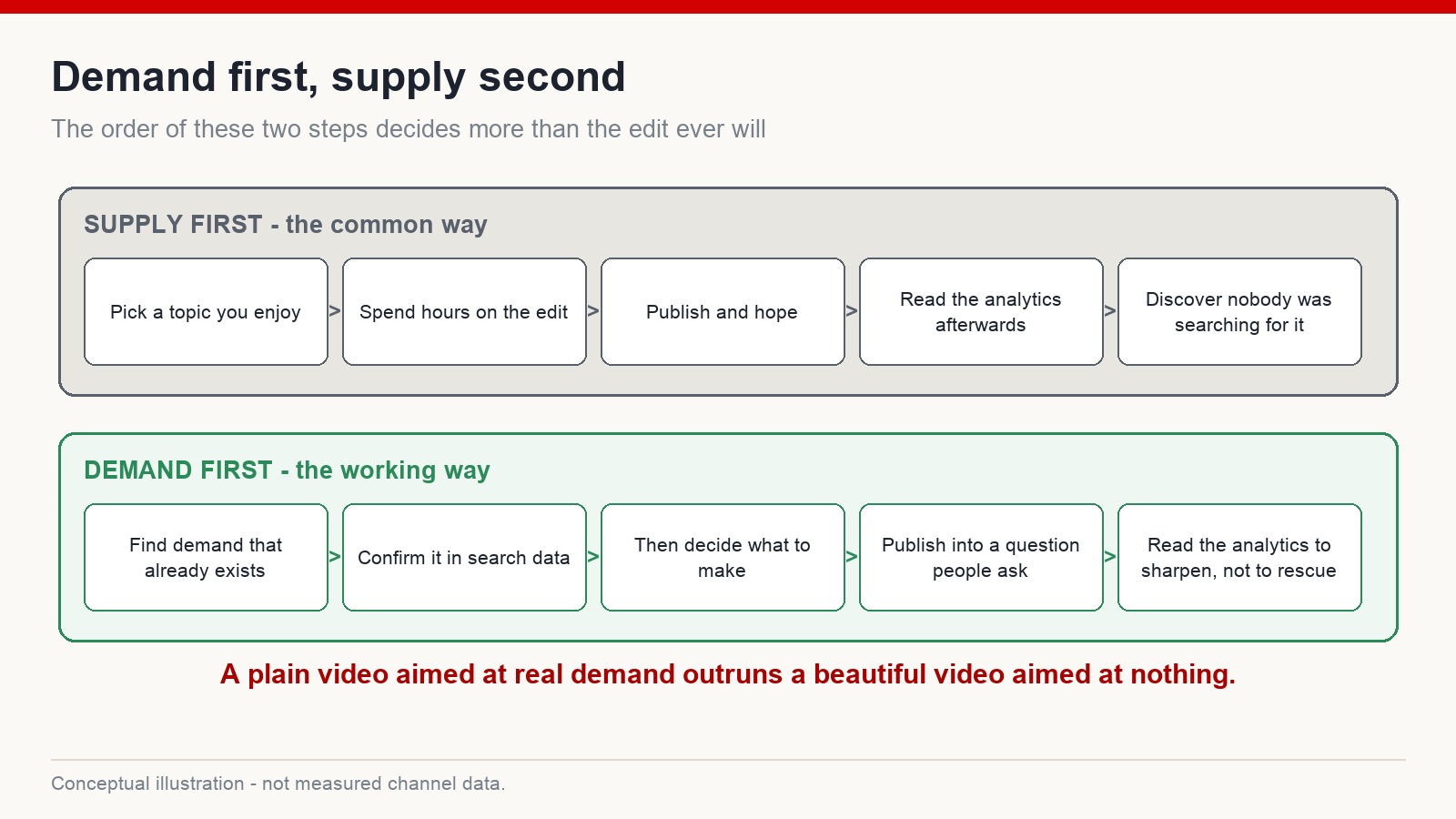
Most people work the other way round without noticing. Pick a topic you enjoy, spend hours on the edit, publish, hope, then read the analytics afterwards and discover nobody was looking for it. The research happens at the end, where it can only explain a failure rather than prevent one.
Demand-first inverts the sequence. Find something people are already asking for. Confirm it in search data. Then decide what to make. By the time you record, the question of whether anyone wants this has already been answered.
Why creators keep pointing at the US market
Large viewership, unusually explicit search behaviour, and advertisers with real budgets. English-speaking markets – the US especially, along with the UK, Germany and Japan – tend to support stronger ad revenue per thousand views than lower-cost markets do. That gap is the honest reason a lot of creators aim there.
But the gap only pays out if the recommendation system has a reason to show your video to anyone. Uploading into a high-value market does not create demand; it changes what existing demand is worth. Everything below is about finding demand that already exists.
The five steps
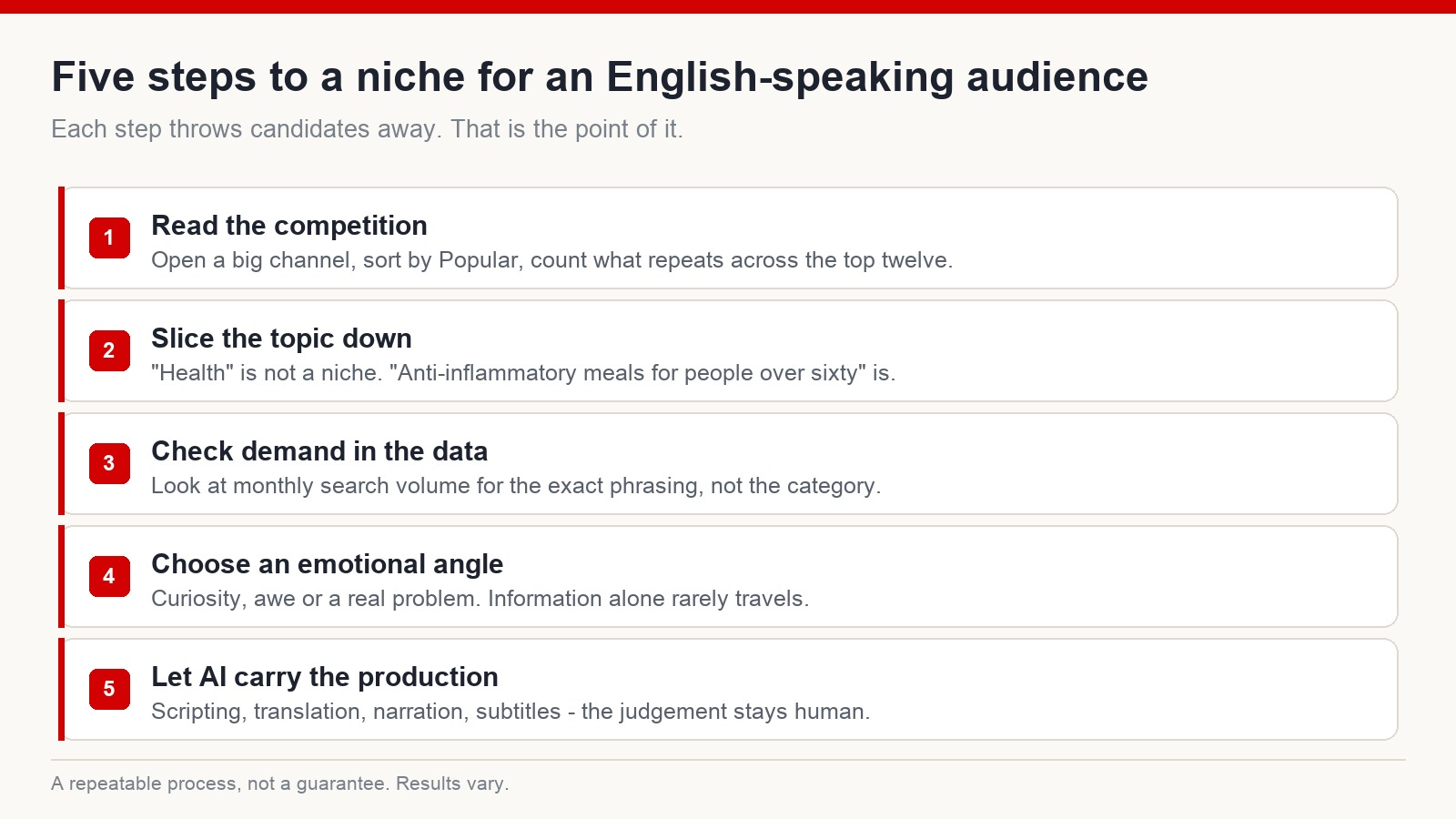
Step one: read the competition for the common denominator
Do not open with “what do I like?” Open with “what are these viewers already watching most?”
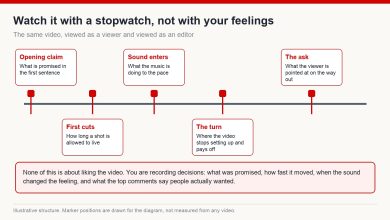
The mechanics are simple. Pick an established channel in the space you are considering. Open the Videos tab, sort by Popular, and look at the top twelve. If more than half of them circle the same kind of content, you are looking at a demand signal that somebody already paid to discover.
What repeats is usually more specific than the category name suggests. Not “animals” but police officers and wild animals. Not “the ocean” but things found in deep water that should not be there. Not “health” but what people over a certain age should be eating. That repeating shape is your common denominator, and it is worth far more than an opinion about what ought to work.
Step two: slice the topic down
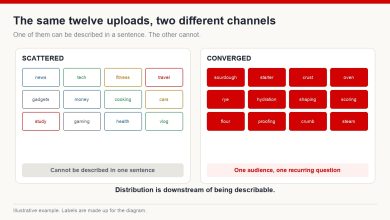
The single biggest beginner error is choosing a category and calling it a niche. Hollywood is not a niche. Health is not a niche. Technology and news are not niches. They are the whole pizza, and you are competing for it against people who have been eating from it for a decade.
Cut it into slices instead:
- Entertainment industry becomes: stars who walked away at the peak, unexplained deaths, what happened after the fame ended
- Health becomes: eating around kidney disease, foods associated with memory after sixty, anti-inflammatory meals for older adults
- Technology becomes: why one specific everyday device works the way it does
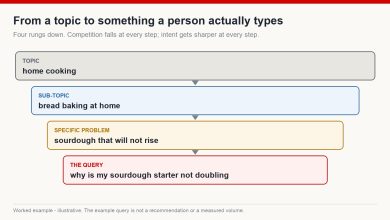
The more specific the slice, the easier it is for the system to understand who to show you to, and the faster a viewer can tell what the channel is for. Both of those matter more for a new channel than production quality does.
Step three: check demand in the data
Feelings are a bad instrument here. Once you have a shortlist of phrasings, look at monthly search volume for the exact phrase rather than the category it belongs to.
A good keyword does not need to be enormous. For a brand-new channel I deliberately work at the small end of the scale rather than reaching for the biggest phrases I can find – less competition, an easier path to the first views, and more chances for the system to test the video at all. That is a personal working range from running these channels, not a published YouTube standard, and I bias it lower the newer the channel is.
One more thing worth checking while you are in there: whether the demand is a spike or a habit. A phrase that only spikes around an event will not carry a channel between events.
Step four: choose a niche with an emotional door
People do not share videos because they were informative. They share them because they felt something. The niches that keep working tend to open on one of three doors.
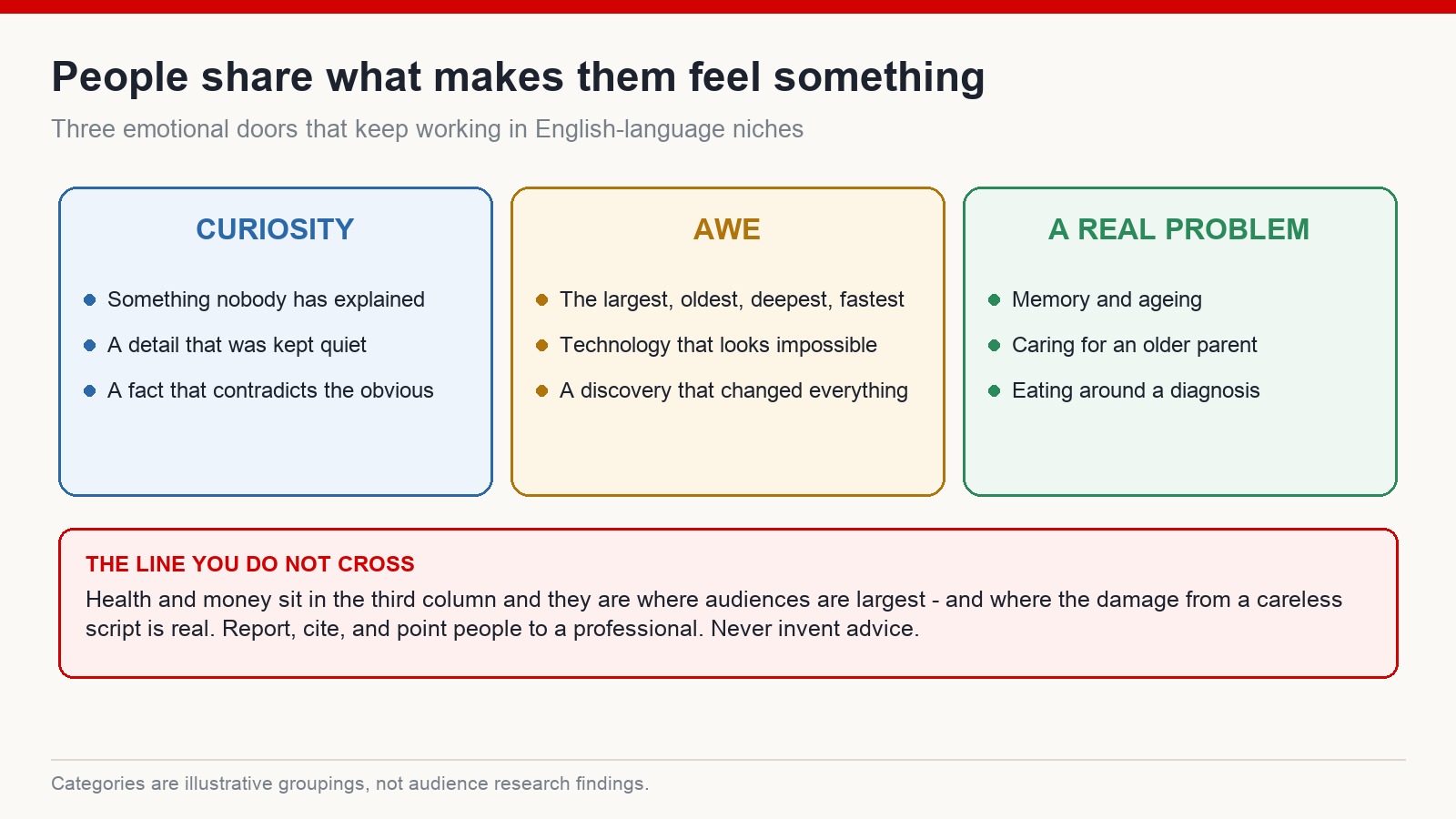
Curiosity: something nobody has explained, a detail that stayed quiet, a fact that contradicts what everyone assumes.
Awe: the largest, oldest, deepest, fastest. Technology that looks impossible. A discovery that reorganised a field.
A real problem: memory and ageing, caring for an older parent, eating around a diagnosis. This is where audiences in English-speaking markets are largest, and where people stay to the end because the video is about their actual life.
That third door needs a word of caution, and I want to be direct about it. Health and money content has consequences for the person watching. Do not invent medical advice, do not promise outcomes, do not write a script that a worried person could act on to their own harm. Report the information, cite reputable sources, and point people to a professional. That protects them and it protects the channel.
Step five: let AI carry the production, not the judgement
A lot of people still believe fluent English is the entry requirement for an international channel. It has not been for a while.
Scripting support, translation, natural-sounding narration, subtitles, faceless production end to end – all of that is available and getting cheaper. Titles, descriptions and keywords do need to be written properly in English so the system can place the video accurately, but that is an editing problem now, not a language barrier.
What does not transfer is the part that decides everything: whether the topic answers a real question for a specific group of people. A tool can produce a video about anything. Only you can decide whether it should exist.
The mistakes that repeat
Nearly every failed niche choice I have looked at contains at least one of these:
- Picking a topic so broad the channel cannot be described in a sentence
- Choosing on inspiration and never checking whether demand exists
- Copying a competitor outright rather than reading why they work
- Switching topics every few weeks, so nothing ever accumulates
- Optimising the edit while the topic itself was never going to land
The channels that grow tend to go absurdly deep into one audience before they widen at all.
Where this leaves you
Building for an English-speaking audience is not a contest of who uploads most. It is a contest of who reads demand most accurately.
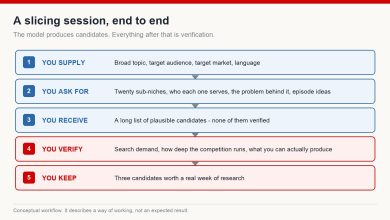
Read the competition and find what repeats. Slice the topic until it is specific. Verify demand in search data. Choose a niche that opens an emotional door. Let AI carry the production while you keep the judgement.
Done in that order, you stop competing with everyone. You only have to be the best option inside one narrow slice.
Is a US-facing channel realistic for a beginner?
Yes, with the niche chosen carefully and the uploads kept consistent. It is a long project requiring discipline, not a fast route to money, and results vary enormously. Keep your expectations honest and you will last long enough to learn something.
Which of the five steps matters most with no experience?
Steps one and three. Reading a competitor’s top videos and checking real search volume are the two that stop you building on a topic nobody wants. The other three sharpen a decision those two have already validated.
Does a narrow niche cap growth?
No. A narrow niche that works expands naturally into neighbouring topics once there is a loyal audience to expand with. The mistake is expanding before that audience exists.
Will AI replace the creator?
Not in the part that matters. It accelerates research, drafting, translation and production. Choosing the niche and deciding what is genuinely useful is still the work, and it is still yours.
Before you publish the next video, spend the extra hours on demand rather than on effects. The right niche can carry an ordinary video a very long way. The wrong one will bury ten good ones.
If you want the whole system for building a faceless channel aimed at an international audience, that is what I teach at mmoyoutube.com. Results vary, and platform policies change – plan for both.